Purpose & Learning Goals
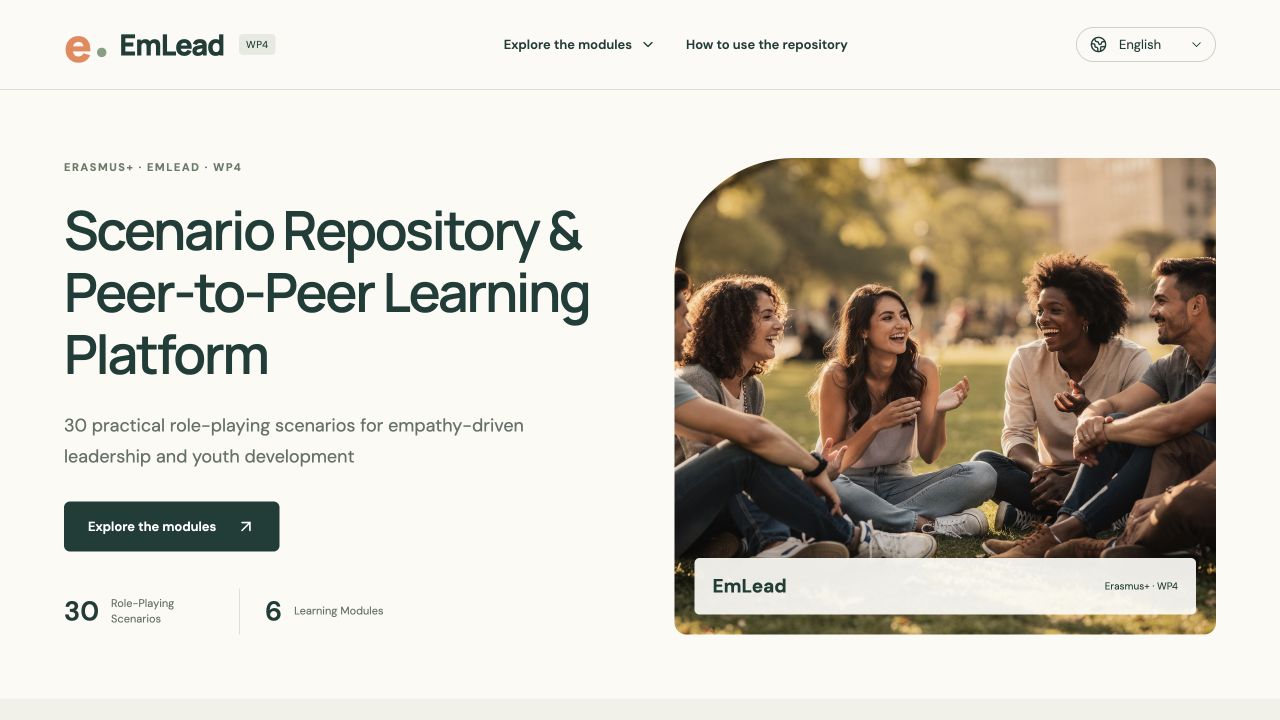
The EmLead Scenario Repository is a practical educational hub containing 30 experiential role-playing scenarios distributed across 6 thematic modules.
Interactive Experiential Learning
Nurtures empathy, active listening, emotional intelligence, and youth leadership through real-life scenarios.
Open Educational Resource
Free, accessible, and ready to use for individuals, youth groups, and non-formal educational activities.
Multilingual Access
Available in English, Spanish, German, Turkish, Serbian, Slovenian, and Italian for maximum reach across Europe.
Choose Your Language & Version
Choose your language in the top-right corner. The interface and scenario content change together. Switching language inside a module keeps the same scenario open; switching here keeps the user guide open.
Select Your Module
Open the modules menu in the header, or select one of the six module cards on the home page. Each module opens directly with its first scenario. Select the EmLead logo to return to the home page.
Browse Scenarios
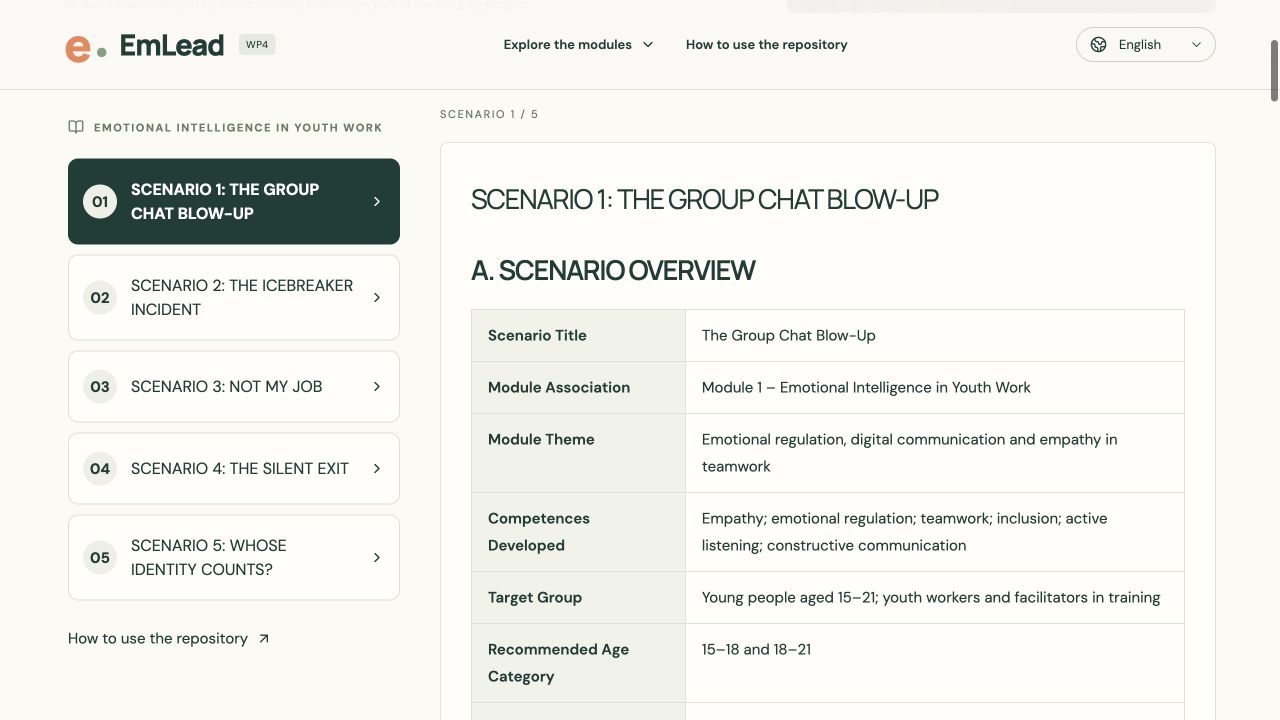
Choose one of the five scenarios from the numbered list beside the content. On a phone, this list appears above the scenario. The highlighted item is the current scenario. You can also use the previous and next scenario buttons at the bottom.
Access Training Materials
Read the overview and learning objectives, then scroll through the context, roles, activity flow, scripts where provided, reflection questions, materials and adaptation notes. Share the page address to open the same module and scenario. For a printed copy, use your browser’s Print command and select Save as PDF if available.
Before the Session: Preparation
Effective facilitation starts before the session begins. Take time to prepare the scenario, the space, and the participants.
- Read the scenario carefully and understand the character roles and emotional dynamics.
- Choose a scenario that fits your group's age, needs, and current learning goals.
- Prepare the space: arrange seating in a circle or open layout to encourage dialogue.
- Print or share participant sheets and role cards in advance.
Materials Needed: A checklist of everything required before the session.
During the Session: Facilitation
Set the scene and let the role-play unfold naturally. Your role as facilitator is to hold the space, not to direct the performance.
- Set the scene: explain the context clearly and remind participants this is a safe, exploratory space, not a performance.
- Assign roles and give participants a few minutes to read their character profiles.
- Let the role-play unfold naturally. Step in only if the group gets stuck or if boundaries are crossed.
- Observe emotional reactions and group dynamics, these will feed into the debrief.
Suggested Role-Play Script: Dialogue with stage directions showing how a session unfolds among participants
Suggested Role-Play Scripts are provided where available. Some scenarios may not include a scripted dialogue and are intended to unfold through participant improvisation.
After the Session: Reflection
Always dedicate 15-20 minutes to guided reflection after the role-play. This is where the deepest learning happens.
- Use the debriefing questions provided in each scenario sheet.
- Ask: "How did it feel to be in that role?", "What would you do differently?", "What did you learn about yourself?"
- Celebrate insights and normalize different emotional responses.
- Consider adaptation notes for different groups, cultural contexts, or online delivery.
Structured debrief prompts to guide group discussion after the role-play.
Guidance for adapting the scenario to different groups, cultural contexts, accessibility needs, and online delivery.
The 6 Thematic Modules at a Glance
30 role-playing scenarios across 6 thematic areas. Choose the module that fits your group's learning needs.
Module 1. Emotional Intelligence in Youth Work
Explore emotional awareness, emotional regulation, empathy and communication through realistic situations involving young people and group dynamics.
Module 2. Role-Playing and Emotional Communication
Develop active listening, emotional communication and awareness of how verbal and non-verbal behaviour influences relationships and group interactions.
Module 3. Soft Skills and Inclusion
Explore inclusive communication, collaboration and social awareness while learning how to recognise and respond to barriers, exclusion and different group needs.
Module 4. Civic Engagement
Explore participation, community responsibility, dialogue and decision-making through scenarios connected with civic action and active citizenship.
Module 5. Intercultural Sensitivity
Strengthen intercultural awareness, empathy and inclusive communication by exploring cultural differences, identity and diverse perspectives.
Module 6. Ethical Leadership
Explore integrity, fairness, responsibility and ethical decision-making through realistic leadership dilemmas and group situations.
Explore the modules →User Experience & Accessibility
The EmLead platform is designed to be open, inclusive, and easy to use for everyone, everywhere.
Works on any device
Fully responsive on desktop, tablet, and smartphone. Learn and explore anywhere.
No login required
Instant open access to all scenarios, modules, and materials, no registration needed.
Accessible by design
Clear typography, high contrast, and intuitive navigation for all users including those with accessibility needs.
Support
This platform was developed as part of the EmLead Erasmus+ Project, bringing together international partners to support leadership education across Europe.
Project Coordinator
Jovesolides is coordinating the EmLead Erasmus+ project and supporting platform users across Europe.
Contact & Support
For questions about using the platform or running a scenario, use the contact information on the project website.
EmLead · emlead.eu ↗